
Practise applying rules and putting items in priority order with this free Dials exercise. Read the instructions and Priority Table, then use the dial readings to decide which item comes first, second and third.
This is independently developed practice material, not an official assessment or a replica of any test provider’s material.
Want more practice applying rules and instructions? Explore Aptitude for Rules & Guidelines, with 200+ practice questions and instant access after purchase.
View Aptitude for Rules & Guidelines →
How to complete the exercise
Rules and Procedures
Your task is to arrange the three dials in order of priority, from highest to lowest priority.
M = Memory
C = CPU
N = Network
- Read the numerical value indicated by each dial’s needle.
- Give priority to the lowest numerical reading, followed by the next lowest, then the highest.
- If two or more dials show the same numerical reading, use the Priority Table to determine the order of those tied dials. This applies whether two dials are equal or all three are equal.
The needles show which numbers to read. The physical positions of the dials on the webpage do not affect priority. Do not rank them simply by which dial or needle appears furthest left or right.
Select the answer that lists the dial letters in the correct priority order.
Priority Table: This is used in the event that the dials are pointing to the same number.
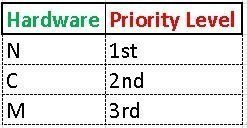
Your task is to arrange the dials below in order of priority:

Take your rules-and-procedures practice further
Build on your practice with Aptitude for Rules & Guidelines. Work through 200+ questions to practise following instructions, applying rules and deciding which gauge takes priority.
Get instant access after purchase and practise on your mobile, tablet, laptop or desktop.
Explore the Practice Package →








This test was ok I would like to be a train driver
Awesome test …. never had better!
Got all correct but still a bit confused by opening statement, “The dials or needle on the left have priority over the the ones on the right”.
If the needle is on the left side of the dial, it takes priority over the needles facing more to the right; the exception being put on Network, CPU & Memory of needles face the same point.
On question 5 all needles look set at 0. Which dial gets priority first?
Refer to the priority table.
I got all of them right once I understood the rule. If the needle is lower, it’s the priority like a low fuel gauge. If the needle is pointing to the same number, the priority is NCM.
Very good test, just wished they would have explained bettter in the actual exam.
I failed this part also the ATAVT element and sitting it again soon , would love some help with it
Practise with the lowest display time. Also, try to understand the definitions of the objects.
Brilliant test. I got 18 out of 21. If you understand the rules this is pretty easy.
So basically the priorities don’t mean anything unless all dials are equal? Otherwise priority is the lowest dial?
The instructions are worded terribly – “Dials positioned on the left take priority over those positioned to their right”. I understood the values were key but they position statement suggests that the layout of the dials in respect of each other on the page has an impact on their priority.
Hi Ryan, thank you for pointing this out. You’re right that the left/right wording is ambiguous and could suggest that the dials’ positions on the page affect their priority. The intended rule is to rank the numerical readings from lowest to highest, using the Priority Table to resolve equal readings. The dials’ positions on the page do not determine their priority. Thank you for highlighting where the explanation needs to be clearer.