
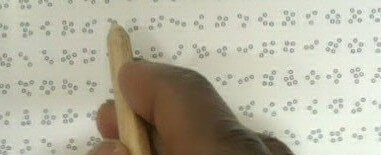
Group Bourdon Test: Train Driver Concentration Practice and Tips
The Group Bourdon test, often called the train driver dots test, involves scanning groups of dots and marking those containing exactly four. The challenge is to work accurately and maintain your attention while completing a repetitive task under time pressure.
Paper Group Bourdon is included among the attention assessments listed in RSSB’s train driver selection guidance. Your assessment invitation and the administrator’s instructions should guide your preparation and what you do on the day.
Looking for paper practice? Our FOUR DOTS Concentration Exercise Book — PDF download provides printable dot-scanning exercises and answer keys. Prefer a book delivered to you? Choose the FOUR DOTS printed workbook.
What do you do in the Group Bourdon test?
You look through rows of dot groups, identify groups containing exactly four dots and mark them as instructed. Groups containing a different number of dots should be left unmarked.
Follow the administrator’s directions about:
- Where to start and which direction to work.
- How to mark your answers and correct mistakes.
- When to move to another section.
- When to stop.
Read any familiarisation material supplied by your recruiting company before practising. Do not assume that instructions from an online exercise will match your assessment.
A simple four-dot example
The examples below explain the counting rule. They are not official test questions or a reproduction of the assessment layout.
| Dots in the group | What to do |
|---|---|
| Three dots | Leave unmarked |
| Four dots arranged in a square | Mark the group |
| Four dots arranged in an uneven pattern | Mark the group |
| Five dots | Leave unmarked |
Count the dots, not just the shape. A group containing four dots remains a target whatever its arrangement. Recognising familiar patterns can be useful, but do not mark a group simply because it resembles a shape you remember.
How to practise for the Group Bourdon test
1. Begin with accuracy
Start with an untimed exercise. Work systematically through the rows, checking each group rather than jumping between obvious targets.
Use the answer key afterwards to identify:
- Missed targets: four-dot groups you passed without marking.
- Incorrect marks: groups you marked that did not contain four dots.
- Tracking mistakes: skipped rows or accidentally checking the same row twice.
Check the area you actually attempted. Record the remaining, unattempted area separately.
2. Introduce a time limit
Once you understand the task, add a timer. Use any practice timing supplied with your candidate materials.
If no timing has been provided, you could use two-minute blocks as a personal practice exercise. This is a training suggestion, not confirmation of your assessment’s timing.
Stop when the timer sounds. Do not add extra answers before checking your work.
3. Review speed and errors together
Record the time allowed, how far you reached, missed targets and incorrect marks.
For example, reaching further while making substantially more mistakes is a reason to review your pace. Try a more controlled approach in your next session and compare the results.
These records help you understand your practice performance; they are not official scores or pass predictions.
4. Use fresh exercises
Revisiting a page can help you understand mistakes, but use unfamiliar pages when checking progress. Otherwise, remembering target positions may make the task easier.
For this routine, use the FOUR DOTS printable practice workbook to work on paper and check your answers afterwards.
Common preparation mistakes
Chasing a particular number of lines. An online target such as “complete six lines” is not a reliable pass benchmark. Layouts and practice materials differ.
Rushing before understanding the instructions. Establish a clear marking method before increasing your pace.
Practising without reviewing errors. Checking your answers tells you whether you are missing targets, marking distractors or losing your place.
Treating general puzzles as a substitute. Sudoku and word searches involve different tasks. Prioritise the familiarisation material supplied for your assessment.
Group Bourdon test: assessment-day tips
Listen to the demonstration, complete any examples provided and ask for clarification before the timed task begins.
If you are unsure how to correct an answer, ask rather than assuming you can erase it or overwrite it. Follow every instruction to start, change sections and stop. Concentrate on your own work rather than comparing your progress with other candidates.
Frequently asked questions
Is Group Bourdon paper-based?
Paper Group Bourdon is listed in RSSB’s standardised train driver psychometric assessment guidance. Check your invitation for the assessments and arrangements that apply to you.
How many lines do I need to complete to pass?
There is no reliable universal line target we can give you. RSSB’s candidate guidance explains that train companies determine the pass marks they use. Practice-workbook results should not be treated as official assessment scores.
Does buying practice material guarantee a pass?
No. Practice material gives you exercises to work through and review. It cannot guarantee an assessment result or a job offer.
Preparing for the Group Bourdon test with FOUR DOTS
Print your own exercises: Get the FOUR DOTS Concentration Exercise Book — PDF download.
Prefer a physical book? Order the FOUR DOTS printed workbook.
FOUR DOTS is independently developed practice material. It is not an official Group Bourdon test or replica and is not affiliated with or endorsed by any assessment provider or train operating company.
Further reading: RSSB and Rail Assessment Centre Forum: train driver psychometric assessment FAQs.




Cheers Isaac
Hi im wondering if anyone can help, i have heard the FGW do NOT do the Mechanical Comprehension Test anymore is this true, any help would be really appreciated thanks.
Can anyone tell me why a Shunter,(not a Shunter driver) has to do a group bourdon test?
Hi Rick,
I can understand why they want Shunters to take the Bourdon Test.
It is basically a tool for measuring your concentration and attention levels.
I surmise that the pass mark for shunters may be relatively low compared to drivers.
Best
I’d forever want to be update on new articles on this website, saved to bookmarks!
Hi i find I am more efficient if i do the test top to bottom (i can read through about 270/360 images) rather than left to right,( I can read through 240/360 images).
Would I be marked down for this?
Yes, you would lose out with that approach. That is you are approaching the dots from a column perspective instead of a row. The test is marked from row perspective. So they check if you’ve completed a row without any mistakes. If no mistakes then you get a score.
Hi!
Are the tests landscape or portrait?
thank you so much for this!
The write up mentions concentration but spells it as concentraion!
Thanks for the correction.
Any tips for train drivers in Australia?
If you list the assessments you are expected in Australia, others may be able to offer tips if they taken the tests before.